

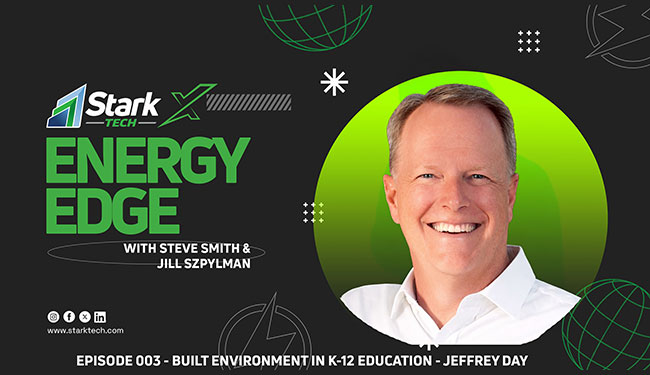
StarkX Energy Edge Episode 003 — The Future of Built Environment in K-12 Education
StarkX Energy Edge Podcast 003
Built Environment in K12 Schools
Hosts: Steve Smith – EVP Sales, Marketing &
Jill Szpylman – VP Marketing & Communications
Guests: Jeffrey Day – K-12 Strategy Expert
[Introduction] On this episode of the StarkX Energy Edge, we’re focusing on the built environment in K-12 education with Jeffrey Day, K-12 strategy leader.
[Steve Smith] Welcome to the StarkX Energy Edge, where today we’re exploring the future of the built environment in education. I’m your host, Steve Smith.
This is my co-host, Jill Spillman.
[Jill Szpylman] Hi.
[SS] Across the United States and especially throughout the Northeast, school districts are entering a critical moment of transformation.
Nearly half of all school buildings in America are more than 50 years old, and many are operating with outdated infrastructure, aging mechanical systems, and disconnected technologies that no longer support the needs of modern learning. At the same time, expectations for school facilities have never been higher. Communities are asking schools to provide safe, healthy, comfortable, energy-efficient environments that support student engagement, academic performance, and long-term sustainability.
[JS] These challenges are driving a new era of K-12 building modernization, one that goes far beyond renovation. Today’s districts are rethinking how schools are designed, powered, protected, and equipped for the future. So let’s explore the major trends shaping the K-12 transformation from energy infrastructure and smart building technology to protective systems, modern learning environments, and the funding strategies that make it all possible.
Let’s get started.
[SS] We’re here with Jeff Day, one of our K-12 strategic and solutions experts on the K-12 area. Jeff, welcome to the podcast.
[Jeff Day] Hey, thank you very much for having me today. I really appreciate you having me in.
[JS] As mentioned earlier, more than half of the school buildings in the United States are over 50 years old. With that kind of aging infrastructure, what kinds of challenges are school districts facing today?
[JD] Yeah, Jill, that’s a great question. And when you take a look at it, I always bring it back to what impact does that really have on the students and what does that really mean to the educational staff? The buildings, as you mentioned, were not originally built to deal with the problems that the schools are facing today, really, let’s face it. And what are those problems? What do we hear as feedback? So from our perspective, again, it’s about creating a healthy, safe learning environment.
And these buildings typically are not air conditioned. When you take a look at it from a COVID-19 perspective, the ventilation and filtration levels are certainly not at the levels that they needed for that whole experience. So today, the challenge is how do we bring those buildings up to date and how can we make the learning experience for students far better than it was yesterday?
[JS] So smart schools is a buzzword, right? That can hold many different meanings. Why do school districts need integrated technology and facility partners like us to help maintain and modernize those buildings?
[JD] That is also a great question. I think as we begin to take a look at what does it take to solve those problems that we articulated, many of the districts that we come in contact with, they have not only old, say, energy management systems and old equipment and electrical infrastructure, but they’re also disparate. Oftentimes, we may come across systems that each building may have a different control system on it.
And if you think about that in your own life, if you had to, say, have like three email inboxes or you had to have three of anything, it’s extremely difficult. And again, if you look at the challenges that these school districts are facing, they’ve got facilities directors who a lot of the great knowledge base is retiring and they’re bringing forward a number of people that obviously are still learning. And if you add to the complication of the mechanical systems, the pressures that are being put upon them, if you then make the tools that they use complicated too, it just adds to the problem.
So what we’ve seen as the right solution there is to, just as you mentioned, begin to consolidate those systems into a single system, a very powerful system that’s extremely well-supported and that we wanna make sure that any of the data that those systems produce is able to flow freely between other smart systems that the schools have invested in. We’ll talk a little bit more about that as we go.
[SS] You know, Jeff, one of the things we know in the built environment is energy costs are getting extreme, right?
[JD] Oh, absolutely, absolutely.
[SS] And it’s interesting is unlike a business or maybe even a hospital that’s run by a board and everything, you know, K to 12, their eye is on the students, their comfort, safety, all of that. But energy efficiency still can play a pivotal role. I’ve heard you talk about how schools can use energy efficiency to actually pay for critical capital projects in their district.
Can you talk about that a little bit?
[JD] Yeah, the team that I work with, we work with energy performance contracting or ESCO work is the acronym for it. And what we’re looking for there is to say what in this building is not as efficient as it should be. So oftentimes that’s lighting, converting to LED lights.
It’s the energy management system updates there. It’s mechanical equipment updates and also building envelope. Those are the big ones.
And what we can do is generate a project that’s very, very similar to a traditional capital project for a school district, but it has a twist. So by quantifying those energy savings and also cost avoidance savings that we can find things like in the future, you may have to update your equipment or you may have to update your energy management system. We can quantify all of that.
And again, it goes right to the state education department for approval. But we use those funds to really help a school district meet their goals. And sometimes those goals are, I would like to have my energy management system updated.
Sometimes it is, I have aged equipment that is failing me. And sometimes we can even help indirectly. So one of the things that we’ve done is actually helped school districts with air conditioning.
So you wouldn’t think of that traditionally as something that would be an energy efficient measure, right? You’re actually creating more energy usage. You know, it’s part of the state’s electrification effort, but you’re right. One of the things that school districts right now being faced with as really an unfunded mandate is to bring the climate control down or bringing the temperature down to either between 82 and 88 degrees.
And there’s certainly regulations around that the state has released recently. But the cost of adding air conditioning is enormous. As we talked about, as Jill mentioned, those buildings in many cases are old and they were never designed for that.
So, the mechanical updates that have to happen are enormous. So what we’ve been doing is really trying to make the school districts, what I’m going to say, air conditioning ready to the best of our ability. And that starts with saying, how do we take the electrical consumption down to its lowest possible rate so that as the school district does have to add electrical load, like for, say, air conditioning, that at the very least, they’re only adding infrastructure for what they need, not any more than that.
[JS] So, you know, you talk a lot about the different challenges that K-12 districts are facing. You know, energy efficiency is one. It’s a small part of it. It’s how we can maybe pay for some of these major capital investments. However, you know, security safety has to be high up on their list. So how have expectations around safety evolved over the years?
[JD] Yeah, that’s a great question. So it’s interesting, you know, kind of looking back on my career when we first got involved with security and safety systems with our team. It was interesting. In those early days, we’re going to talk like pre-Columbine.
That’s how far back we go with this whole thing. Security systems were really thought of as almost, well, like too much for a school district, you know, because schools, let’s face it, they’re designed to be an open environment, a friendly environment, open to the public. But as soon as those tragic events began occurring, you know, it was obviously now the time to secure those vulnerable places.
And where it began really was securing the perimeter. So I would say in the early days, it was all about making sure that you could control who entered the building. And then very rapidly, it became controlling an entryway for those people to come in and get vetted.
Because again, those older buildings that we talked about, many of them did not have a logical place for people to even come in. You know, it was just, if there was a doorway, people were flooding in. So, step one of that whole thing was securing the perimeter and having a logical place to bring people in.
So, you’ve seen a lot of effort around that over the last few years. But the evolution seems to be, number one, making the building locked all the time. It was not that long ago that we even were scheduling, you know, when the buses came, you’d unlock the doors.
And, you know, after hours, the doors would unlock. You know, really at this point, for the most part, the buildings are secured and people are buzzed through, if you will, to be vetted. What we’ve seen happening, though, is that there’s been a lot more work of late on the interior of the building.
And all of the research that we’ve read is that no one in one of these tragic, tragic situations has ever been hurt behind a locked door. So the real effort is to get behind a locked door. And one other thing that we’ve talked about amongst our group is that when someone is faced with a real challenge, well, maybe put it this way, when someone is faced with a terrible threat, your fine motor skills leave you.
That’s really the issue. So if ever there’s a situation where your lockdown solution or your ability to get behind a locked door is challenged because, you know, you are in a, I’m going to say, a degraded mode, it’s just natural, it’s human, right? We have to have the systems be very simple and be very reliable. So what we’ve really focused on is A, making it so that the primary initiation for lockdown is very simple.
It’s lift a cover, press a button, and then the automated systems take over from there. What we’ve also found is, again, that with that concept of getting behind a locked door and having that really be the best approach. We’ve started to really do projects that are heavily around interior card access.
So, we’re doing a lot of school districts now where the classroom doors are actually access controlled. And it does a lot of great things. Number one, it makes sure that in the event of an emergency, we can make sure those doors are locked and people can get safe.
But there’s also added benefits outside of the emergency side. Like, for example, it eliminates that whole situation with a master key getting loose and who can have access to
what key. So, there’s, what you find is that there’s auxiliary benefits that are real important too for just the day-to-day operation of the school.
But, and that’s on the access control side and the lockdown side. What we’ve seen on the video surveillance side is that, again, in the early days, it was very much exterior of the building, especially in elementary schools. It was about making sure a child doesn’t, you know, get lost or something.
And in the high schools and middle schools is all about really interior focus because in those schools, you had situations where there might be a fight or there might be a medical emergency or something like that. What we’re seeing now is that the cameras in particular are, you can’t get enough cameras, it seems like. And, you know, you’re on video for the moment you enter the parking lot to the moment you exit the parking lot, really.
And that’s a good thing because really that is a great deterrent for problems. And the schools really use that not only to, you know, make sure that their students are safe, but we’ve also found that it’s helped them a lot with their insurance and all that. If there’s a slip and fall issue or something, you know, that it’s managed correctly.
[JS] So what I really like about what you’re saying is, yes, you’re there to prevent the major catastrophic events that we hope never happen. But really these tools and these technologies are really meant to help with everyday activities too, right? You mentioned slip and fall, you mentioned medical emergencies. You know, the other day, my son, I got a notification on my phone that the school was in lockdown because of a medical emergency.
So, these types of notifications go beyond, you know, the unthinkable.
[JD] It’s true. It’s true. And, you know, and honestly, that’s a wonderful observation because, you know, one of the other pieces of the puzzle, especially with the lockdown, has to do with the enunciation of that, right? So, one of the other big pieces is, can we, you know, how do we tie into a public address system and digital signage and all of that?
And to your point, one of the wonderful things about that I found is that if we do use the public address system for things like bell schedule and announcements, but we also use it for a critical event like lockdown, you’re using it all the time, just like you mentioned. They’re wonderful active systems that get exercised multiple times every day. So, you have a high degree of confidence that they will work when they need to work on the worst day.
[SS] They should become part of the day-to-day at the school. Absolutely.
[JD] Absolutely.
[SS] Yeah, but playing that critical role.
[JD] Yeah, 100%.
[SS] Jeff, great description of how the schools are using technology. How are districts using this technology, such as video analytics or integrated communication systems to enhance the situational awareness and just overall awareness within the environment?
[JD] Yeah, that’s a great topic. Obviously, the rise of analytics, we see it in our own life.
It’s become very, very approachable for all of us. And the same is true with, certainly on video. That’s one of the places you see it happening very rapidly.
And it wasn’t that long ago that we had kind of basic analytics, things like, did a vehicle go the wrong way? Or did a person enter a playground that shouldn’t? They were kind of very rudimentary. And quite frankly, in those early days, even though the systems had them, they weren’t used that much. And the reason was, is that it was difficult to set them up or to calibrate them and that sort of thing.
So, although they existed, I felt like it was still kind of early in the life cycle for analytics. What you’re starting to see now is that with the rise of AI and the rest, those analytics are now just sort of happening automatically. So, it’s finally gotten, I think, past that early adoptions phase to where it’s really starting to get some great value.
And some of the systems that we’ve been involved with, they’re actually really doing some creative things with it. So, for example, we now can understand if it’s a school bus and what school the school bus is with and what street did it turn on. You can do all kinds of incredible things and you can start to ask the system things like, show me all students who are using their phones in the hallway. Because right now that’s an issue, right? I can’t imagine being poor kids in high school. I feel bad for them right now. Yeah, yeah.
But-
[JS] They’re not supposed to have them.
[JD] I know they’re not supposed to have them. Yeah. Or we even challenged it a little bit to say, show me all students who are vaping. And now it’s not perfect. Once in a while you get someone who might’ve been bringing something to their mouth like a candy bar or something that kind of looks like a vape pen.
So, it’s not perfect. But it certainly goes a long way to eliminate the time that’s necessary for searching through your video. Because again, earlier we talked about the rise in the number of cameras, so now there’s a massive amount of data coming at you. And the challenge for the school district and the professionals who are using it is how do you pair through that data rapidly to get exactly what you need very, very quickly. And that’s really what the analytics are there to do.
And there’s another caveat that goes along with at least K through 12 in New York State. And that is that we cannot use the facial recognition feature. That’s not legal and appropriate, which is fine. But we can do things they call pattern matching. So we can say, show me all people who are wearing a black shirt and maybe khaki pants or something that were outside walking in this area and circle of zone. And what it does is it rapidly takes you to that finding.
[SS] Yeah, so rather than the investigation requiring or any type of research all hours and hours, the analytics really helps.
[JD] Yeah, a hundred percent.
[SS] We talk about that a lot with other areas of our business and the built environment too.
So, it’s interesting to see how it plays there. So, one of the other things we talk about and have talked about in other episodes of the podcast is integrating all this technology, right? So, when it comes to security and protective systems, why is it important to, and why are school districts seeing the benefit of integrating the technology rather than it operating standalone?
[JD] Yeah, that’s a great point. And I think, and that’s a tough one because you invest as a district, you invest in all these technology systems.
And oftentimes those come across multiple capital projects or multiple smart bond projects or pick your funding mechanism. The point of the matter is, is that they’re coming at the district’s disparate. It’s what they can afford at the time.
And what you really would love to have is to extract the greatest value out of all that data that these systems are generating, right? And then you also have to balance, you want them to be very, very reliable once it’s all done. So you have to, I think, start with a great roadmap that talks about what systems am I gonna choose and how are we gonna tie these together in a reliable way? And really, quite frankly, you’re talking about with security anyway, you’re talking about, I hate to say it, the lives of children and the lives of teachers and administrators. This is serious stuff.
So what you can’t get tempted into is a bunch of disparate systems that have, what I’m gonna say, not ruggedized connection points that are vulnerable to say if one system gets upgraded to a firmware version and it’s not compatible now with the other system, you could find yourself in a position to where two data systems now don’t talk on the most important day when they need to. So what we’ve really promoted is the idea that you need to have an integrator that understands all these different systems or even better yet, if you can get them under one integrated platform, better still, you know? And so what we’ve tried to do is to say, okay, for the core functionality and by the core functionality in security systems, I’m talking lockdown. That’s the one that has the biggest life safety piece around it.
We wanna make sure that that component is as ruggedized as we can come up with. So our team came up with a concept of saying, we’re gonna create basically a panel or a nucleus in every single building that is responsible for the physical lockdown button and the calling of the authorities. And that’s gonna be super ruggedized.
And then what we’re gonna do is within that environment, we’re gonna create an ability for everything to flow in and out of that panel or that nucleus. So the ability to have the announcement go over the PA system, the ability to have the doors locked, you know, the ability for digital signage to trigger, blue lights to trigger. And what we did is we tried to create it, again, an open environment.
So you do have the ability over time to take advantage of the best-in-class systems as they evolve and become available, but yet keep it in a construct that’s safe and reliable.
[JS] That’s great. What an exciting topic today, right? I mean, it’s across the country, and we focus today on New York state, but school districts across the country are facing this pivotal moment, you know, aging infrastructure, rising safety expectations, evolving learning models. They’re all converging and reshaping how we look at education.
Modernizing school buildings is no longer just about updating equipment or, you know, renovating aging infrastructures. It’s about creating environments that support student success, number one. It’s protecting our communities, and it’s really operating efficiently, you know, and when we can do that, we can adapt to the needs of the future.
So, thanks for listening in, and we’ll catch you on the next episode. Thanks, Jeff, for joining us today.
[JD] Great seeing you guys. Great, thanks.
[Outro] Thanks for listening to the StarkX Energy Edge podcast, a production of Stark Tech.
If you’re viewing this on YouTube, please like, share, and subscribe to our channel, and leave a comment below. We’d love to hear from you. If you have a question or an idea for a future episode, email marketing at starktech.com. Follow us on social media, and we’ll see you here next time on the StarkX Energy Edge podcast
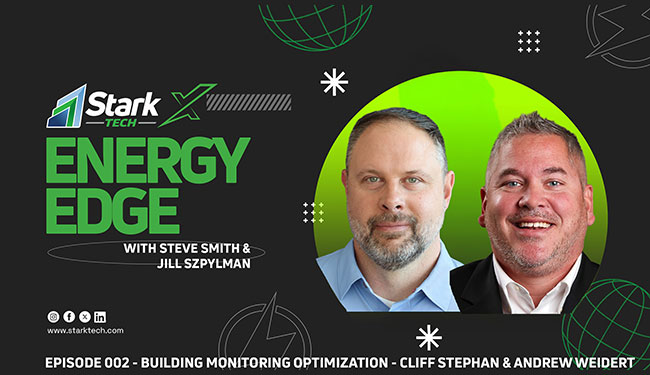
StarkX Energy Edge Episode 002 — Optimizing Building Controls
StarkX Energy Edge Episode 002
Optimizing Building Controls
Hosts: Steve Smith – EVP Sales, Marketing &
Jill Szpylman – VP Marketing & Communications
Guests: Cliff Stephan – SVP – Enterprise Engineering & Building Intelligence
Andrew Weidert – VP – Project Solutions & Business Development
[Introduction] On this episode of the StarkX Energy Edge podcast, we’re talking about building controls, monitoring and optimization, what to look for, why it matters, and an efficient way to do it. Now here are your hosts, Steve Smith and Jill Spillman.
[Steve Smith] Hello and welcome to the StarkX Energy Edge podcast. I’m your host, Steve Smith.
[Jill Szpylman] I’m also your host, Jill Szpylman.
[SS] And today we’re talking with our guests, Cliff Stephan and Andy Weidert, on the importance of analytics and how optimization isn’t a one-time setup, but rather an ongoing process of continuous improvement, of collecting system data, understanding the data, and then implementing strategies and actions to gain energy efficiency, reduce energy costs, and ultimately run smoother operations.
So, but I think first, we have to understand the difference between analytics and building management. So, Cliff, I’m going to start with you. What’s the difference between building analytics and building management systems?
[Cliff Stephan] Yeah, thanks, Steve. Building management systems, traditionally, our control systems that we deploy, are made to operate in control buildings, right? They’re not really good at data acquisition and telling the story historically, right? A lot of times when people use their building control systems, they’re looking to see if their space temperatures are within tolerance. They use them to adjust the temp, right?
They use it to change the schedules. But other than that, they don’t really get a whole lot of value out of the whole thing, right? They don’t really see what’s going on behind the scenes.
I mean, a lot of times what happens behind the scenes is you could have, you know, controls software that’s a little bit off, or you could have things that just aren’t quite right, but the controls will make up that difference, right? It’ll keep the space satisfied, keep people happy, but we’re wasting a lot of energy, you know, in the meantime.
The analytics gives us the ability to take a lot of data out of these platforms, and it’s not just the VMS platforms, but it’s our energy platforms, our power monitoring expert platforms, our utility bill monitoring platforms, but it gives us that ability to take all that data in, normalize it, and really tell the story about what’s going on with the controls and how they work, right? Gives us the ability to go back, make adjustments, save energy, and report out.
[JS] So you mentioned a bunch of different systems. You said power monitoring, you mentioned building controls. Why does that systems integration matter?
[CS] There’s a lot of different sources of data, right? So your building automation and control systems typically are all the sensors and stuff that are inside the building. Our utility bill management system gives us abilities from the utilities, right?
So rate structures, cost of energy, that kind of stuff. We can bring it in and normalize it to what’s going on. We have power monitoring expert that tells us real-time what the energy usage is in the building over the top of building automation and controls.
So by bringing all that together, it really tells a story, a complete story about what’s happening with the facility.
[SS] Cliff, thanks for clarifying the difference between analytics and building management systems. That makes a lot of sense, particularly the work you’re doing at Stark Tech.
What are we doing in the world of analytics?
[CS] Sure, thanks for asking. Starting back probably about 15 years ago, we saw the need for this, right? We saw coming up through, all we have is BMS systems. And it was always hard to understand what was going on in the building when we weren’t there, right? If it wasn’t something that was happening at a point in time, it was hard to capture that.
So, we kind of early adopters back in 2012, 2013, we got into this data overlay and analytics platform work, right? That carried us into some pretty large customers that are nationwide customers, 1,300, 1,400 building deployments. Some of the biggest data analytics style databases up in Azure in the world right now.
But it taught us a lot, right? It taught us about how to crunch that data, get the value out of the data, how to build optimization projects, how standards are so important in the industry, right? So, going back three, four years ago, we made a decision to start at Stark Tech to take what we’ve learned with these big national accounts and bring it back into our install base, right?
So, we, at the time, decided to build our own platform, Optelligent, right? It’s a data analytics and overlay platform that’s able to take data from all sorts of data sources, right? You can scrub stuff off the internet.
It can get stuff through MQTT, from your building automation and control systems, from our power management systems. And we run it up into an Azure cloud where we have a team that was developed over time on these big national accounts of very bright, smart engineers. We have PhDs on staff. We got aeronautical engineers.
But just really good engineering knowledge that goes into taking this data and having some good outputs from it, right? So, things we’re doing today, we are proactively serving information to our service department so they can go out there with the knowledge of what’s wrong in the building before they even get there, which is a huge time saver for both us and the customer.
Optimization projects, to Andy’s point, where we can tee up programs that involves complex installations of equipment and controls to really help facilitate energy savings. I would layer in there, too. You know, listen up, building owners.
[Andy Weidert] This is your ability to become proactive in your buildings, in your campuses, in your portfolio versus reactive. A lot of what we do, a lot of what you’re challenged with on a daily basis is reactive. You’re firefighting.
You’re keeping your processes. You’re keeping your schools open. The overlay and the understanding, the expertise, the analytics helps you become more proactive in that endeavor.
So, when you really think about it holistically, you’re really taking a defensive mindset to more of an offensive mindset and how you approach and optimize your building.
[JS] So I think just on a point to that, what’s really neat about our customer base and those that are out there, they all have the systems in place. They just need the overlay on top of it to then really be able to take the actions that are needed to optimize their buildings in a proactive way. To your point, not reactive, but really preventative.
Really, what’s the next stage? How do I future proof this building to stay optimized at all times?
[CS] Once Optelligent is connected to the building too, it’s 24-hour continuous commissioning. Think of it as like a virtual technician that’s always watching over your building and keeping it on track. When something starts to deviate, we know about it much quicker than we’ve had in the past. And to Andy’s point, it really does put you on the offensive foot. We know what’s going on prior to somebody getting a phone call saying, I’m cold or something’s broke. And that’s where the industry is going.
[SS] So now that we have a better understanding of analytics, management systems and the importance of that. Andy, when you think about all the challenges facing the market today, building owners, what are some of the things and how does it relate to this topic?
[AW] What do you think? I mean, just to pull it back up to 30,000th of you, you think of the complexity you have in your own home of trying to keep everything connected together, running and working. And then you magnify that times 10 or 100 times when you go into a commercial environment, a campus, an industrial facility. And you’re laying in the complexities that they have in those facilities.
That alone in itself is a difficult challenge. You layer on the fact that now there’s an increased demand for improving, lowering your OPEX spend, improving your energy efficiency. Depending on what state you’re involved in, there’s heavy initiatives to also reduce your carbon. And along with that, on top of that, you’re trying to electrify your facilities. So when you talk about the challenges that building owners are having today, and it spans across all aspects of our business, K through 12, industrial, health care and all commercial buildings. There’s this ever pressing challenge that’s continuing to become more prevalent, that the buildings are getting smarter, just like your home is getting smarter.
The challenges on making that system stay up and operate effectively, as Cliff was talking about earlier, making sure they’re optimized. And then these additional challenges that are now getting layered on top. You know, you take a K through 12 school, cooling, electrification, reducing your carbon load and becoming more energy efficient. And depending what state you might be in, also electrifying your bus fleet. This data, this information and the complexity of how it all flows together and what you can do with it is putting a heavier emphasis on the need for a solution like ours and Optelligent and Data Analytics.
[JS] So we talk a lot about these challenges. We have a multitude of different customers. You know, you have K through 12s, hospitals, manufacturers.
They all have different challenges. But what was something that we did, Stark Tech did, to address these challenges that our customers were facing?
[CS] Let’s start with K to 12. Right. So K to 12, you know, we’re going through one right now.
It’s a good example. You know, it’s cold out in Buffalo. It’s 14 degrees right now. You know, some of the challenges they’re having is trying to trying to keep the buildings warm. They got antiquated equipment. You know, they’re running occupies 24-7 and there’s issues.
It goes back to that whole deal where the space is fine. It doesn’t seem to be anything wrong. We’re not freezing coils, but we’re also, again, using a massive amount of energy to do this.
Right. You know, looking through the utility bills in the last three months, the delivery charge has doubled. Right.
So we went from 18 cents to 30 cents. This is substantial. The disconnect between the front office who pays the bills and the guys that are in the back office just turning the schedule on and running the build in 24-7, there’s a disconnect there. And this is where I think Optelligent will help bridge that gap. But it’s a big deal when somebody just adjusts the schedule like that right now. Right.
So now as we go through it, we’re finding out all the pain points and things that are causing that guy to turn that schedule, you know, to 24-7 type occupied. Then we’re able to pinpoint those really quickly, get our service dispatch out there to fix those problems and get these buildings so they don’t have to run that way anymore. And I think that’s a I mean, it’s a it’s a big one right there.
[AW] I would say, you know, it’s a great point in regards to utility rates going up. Ultimately, what happens is the rate goes up, the accounting financial side, the CFO goes to the facilities manager and says, you need to reduce your OPEX spend by 5 or 10 percent. Yeah. Where do you start from there? What’s the roadmap? How do you start to systematically attack how that happens without compromising what you’re trying to do in the space?
Well, having access to that data and understanding the trends and where you might be able to turn small dials to make big changes. That’s really ultimately where this all starts and stems from. Everyone would love to be able to do big capital projects and replace all equipment with new energy efficient equipment and put in all brand new control systems.
But in all practicality, this is a slow progression. And having the analytics and the data be able to make small dial turns to start putting you on that path and keeping you aligned with what ultimately the company needs. A lot of large corporations are setting mandates for an energy reduction spend year over year.
Some are 5 percent, some are 10 percent, some are even more aggressive. You really need to start with that roadmap and having the data helps you with that roadmap. Yeah.
[CS] I mean, along with that, such as dial turning too, we’re able to scope optimization projects. So, if we see things going through the data that are systemic, we see where there’s a program to be done, equipment needs to be replaced. We can start to build up a catalog of optimization projects that we can then filter out to the rest of the company and then we have solutions that are available.
So, when those questions do come up or there is capital available, we have solutions and plans in place.
[AW] I mean, it’s a great point. That’s the exciting part about being a part of a data driven company, is when you have the data and you have the expertise to understand and analyze it. All of a sudden you become very important to your best customers. So, you know, to simplify it the best, that’s really the critical nature behind the data and the ability to analyze it and give it back to them and something they understand and that can take action on, like some of those big measures. It’s worth its weight in gold.
[JS] So we talk about all these challenges and things like that. I’m sure just like we’ve experienced in our own business and other businesses, AI is driving a lot of conversations. How do you integrate it? How do you use it to gain efficiencies? So, what are some of the things that we’re playing with and how are we using it for our customers?
[CS] Yeah, great question. You know, the world’s changed so much in the last six months, right? So, it’s awesome that we have these systems.
We put things in place. We were kind of ahead of the game there. But what was happening is we got this tidal wave of data coming in and we have people that are really good engineers and PhDs and analysts, right, that are going to take this data and create useful reports and smash it all together.
What AI enables to do is to filter through that data at a rate that is unbelievable, right? We get to a result much quicker. So, I don’t have the analysts out there trying to find the data and pull the data out of the platforms. They have results that are coming in from the AI and then they spend their time kind of going through those reports and making sure they’re what they need to be and spending their time doing proper engineering work, right? So just on the report generation side, just think about writing a term paper for like an optimization project. It took a lot of time, right?
And scale was kind of an issue prior to AI. Now we don’t, you know, we can use AI to write the term paper. So, it’s just a game changer on our ability to deploy at scale.
[SS] Yeah, that’s interesting because I was trying to think about how the AI interaction with the human engineering interaction works together. And I think what I’m hearing you say is that the AI allows you to comb through the volumes of data more quickly, provide meaningful insights, but it still requires that solutions driven human problem solving to work through and to look for the biggest bang for the buck or is that how it works? Exactly, exactly, right?
[CS] And it’s just, yeah, it’s amazing.
[AW] There’s a lot of noise that can exist when you walk through a facility. Things that intuitively have a great solution and ability to pay back and make sense. And there’s a lot of things that might seem good, but ultimately when you analyze the data, they’re not good. So, the ability to comb through, let’s say 80% of that and then overlay our expertise in the last 20 to your point, Steve, of all right, the data has been crunched. It’s been analyzed.
Now we’re going to overlay our expertise on top of that to really point you in the right direction. That’s really where those emerging technologies and our expertise meet in the middle, if you will. So, it’s a good harmony.
[SS] Well, thank you very much for your time. I want a big thank you to Cliff and Andy for their time and their insights and their experience. You can tell some more industry experts here on the StarkX Energy Edge podcast.It really sets the stage for conversations we’re going to have more and more in the future. And of course, thank you to our listeners for tuning in and listening to our experts this time. Be sure to subscribe so you don’t miss future episodes.
We have plenty more to come as we continue exploring how facilities remain resilient, efficient, and prepared for what’s next. Thanks again.
[Outro] Thanks for listening to the StarkX Energy Edge podcast, a production of Stark Tech.
If you’re viewing this on YouTube, please like, share, and subscribe to our channel and leave a comment below. We’d love to hear from you. If you have a question or an idea for a future episode, email marketing at starktech.com.
Follow us on social media. And we’ll see you here next time on the StarkX Energy Edge podcast.
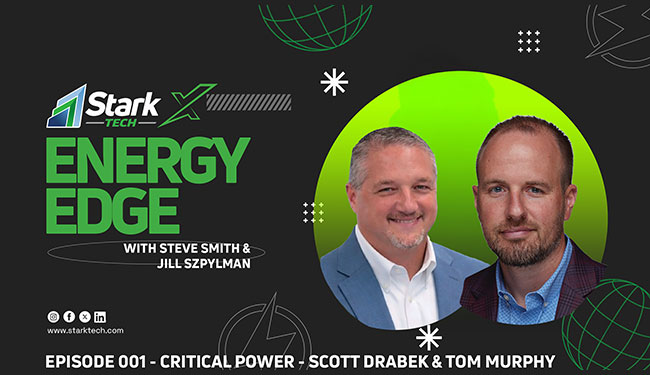
StarkX Energy Edge Episode 001 — Critical Power
StarkX Energy Edge
Episode 001 – Critical Power
Hosts: Steve Smith – EVP Sales, Marketing &
Jill Szpylman – VP Marketing & Communications
Guests: Scott Drabek – VP Client Success & Solutions
Tom Murphy – Branch General Manager, VP Sales
[Introduction] Welcome to the StarkX Energy Edge, a monthly podcast focused on the latest innovations in building energy applications, efficiency, and total building optimization. In this episode, we’re diving into the world of critical power, the backbone that keeps businesses and facilities running without interruption. We’ll explore what critical power really means, the hurdles organizations face in keeping their systems resilient, and what businesses can do to maximize efficiency and keep operations running smoothly.
Now, here are your hosts, Steve Smith and Jill Szpylman.
[Steve Smith] Good morning. Hello, and welcome to the StarkX Energy Edge podcast, where your hosts, Jill Spillman and Steve Smith. So the StarkX podcast is a new podcast where we’re going to talk all things building and facility solutions, really working on what challenges we have, and we’re going to have esteemed panel guests helping me and Jill kind of talk through those situations.
Today, we’re tackling the topic of critical power, bridging the power gap. Jill, who do we have with us today?
[Jill Szpylman] We’ll be talking with our in-house experts on power solutions. We have Tom Murphy here and Scott Drabeck. Welcome to today’s episode.
Over the past 18 months, electricity rates have been rising at unprecedented rates. That’s why this topic is so important for this conversation today. Some of those factors include grid reliability challenges, digitalization boom, which has added more load onto that electrical grid, which is causing issues in our customer bases, and then regulatory initiatives that compel investments in technology to protect our power resilience in our buildings.
Steve, you want to start asking some questions?
[SS] Yeah, sure. So when you think about the fact that projections have that these rates are going to increase up to 25% by 2030, building owners are facing this. You guys encounter this every day.
Let’s start with this. So what are some of the industries that we’re working with that require these types of power systems?
[Tom Murphy] We’re definitely seeing power systems in manufacturing spaces where the critical nature of the operation, if there isn’t uptime, there’s significant value reduction for that business. So manufacturing is a big one. Anything that’s reliant on IT, which is most all
industries nowadays, most companies have some type of network hub or compute stack in a space locally, call it a server room or a small data center, depending on the nature of the business that they serve.
So we’re seeing across all industries, really, the nature of power systems for resiliency purposes is a driving force for capital expenditure and OPEX considerations overall.
[Scott Drabek] I think adding just a little bit, too, is you take some of those critical environments like the healthcare, pharmaceutical side of the world, too. Always resiliency, always that uptime side of it, like Tom mentioned. So it’s always critically important to them in that environment, in that world, to have reliable power, have the uptime, especially when you’re dealing with patient care and life-saving solutions.
And pharmaceutical, adding it to some of the manufacturing side of it, like Tom’s talking about, these are areas that we see today putting a lot of focus around their power, their critical power, and really where their energy is going.
[SS] Yeah, I used to work at a manufacturing company, and we considered what we did critical, mission critical, right? Because if our product wasn’t there, the line stopped, right? But I can’t imagine with these power challenges and power going out and different things, if you’re in a hospital setting, whatever, it’s going to be huge.
So that makes a ton of sense.
[TM] Yeah, and we see it quite a bit in higher education, right? Higher education receives grants for research and things like that, right? And a lot of that research is stored in some type of digital infrastructure.
So the continuity of power for those applications is high. The distributed networks that need to be backed up are critical as well. So that’s a vertical that is heavily invested in the infrastructure that we support typically.
[JS] With the rise in utility rates, have your customers been saying to you, we need things sooner than later? Has it changed the dynamic and the urgency around it?
[TM] Yeah, that’s a great question. Typically, our customers have been very focused for years on just power availability, right? And things like efficiency and the cost of their infrastructure have been not as critical because they’re just looking at it as, I need to ensure that my business operation stays up and can operate.
We’re now starting to see the nature of rising operating expense challenges from the utility costs beginning to spike, becoming a conversation piece that they need to plan for.
[SD] Yeah, I think it’s become this balance, right? There’s a rising energy cost, which everybody’s always got a focus on. You’re trying to balance your operational costs and the rising energy costs with it.
And then you’re dealing with the fact that you are in a critical nature environment, to some of the places that we just talked about. So you’re trying to make sure that you got your uptime, you’ve got your systems in place, you have utility grids and power grids out there
that are being challenged, and it’s affecting how facilities and buildings operate. And then you’ve also got the energy costs, the operational cost side of it.
You’ve got infrastructure side of it, right, Tom? So it’s becoming this whole mix of what’s really the most important to the end user, right? And it’s a very tough balance.
And they are coming to us and asking, what do we do? Where can we go to really mesh the two together, knowing that we have to have uptime and that requires infrastructure and that requires solutions, but how do we balance that with some more energy efficiency around that part of it?
[TM] Yeah, and we’re even seeing the manufacturers that build and supply product in the marketplace, their roadmap and position in the market is shifting. They’re moving away from just being a systems provider for, say, power generation or transfer switching equipment, and they’re shifting more towards trying to be an energy management, power management technology company, right, where some of that is shifting into things like connectivity or just new innovations and how to help the overall management of energy versus just being a system that is there for standby or conditioning purposes.
[SS] You know, as I hear you guys talk about it and I think about the dynamics going on, the word that comes to mind is uncertainty, right, like when you talk about the balance and the need for businesses, this is going to affect all of us, right, in our homes and wherever we live, but we’re here talking about buildings and real estate owners and the challenges they face. And when you talk about they need to find that balance, it’s got to be a very difficult time for them, right? They’re seeing energy expenses being such a huge part of their P&L, their profit and loss, right, their balance sheet now.
So from that, in these uncertain situations, what are steps that you’re talking to your clients and customers and partners about that they can take right now to help keep their systems reliable while also kind of setting them up for future success and avoiding some of this, some of this, you know, cost avalanche that’s coming at them?
[SD] I think it’s a combination of a couple of factors really, right? First and foremost, it’s what’s the most important to the customer. What is their overall master plan and their vision?
From a prioritization standpoint, you know, we talk about the resiliency, the uptime, you’re talking about balancing energy efficiency, and then it’s also where that organization, that business, the buildings or the campus may be headed, you know, is there future expansion, is there future modification that’s going to come with some of their master planning? So, understanding, I think, and knowing where they’re headed and where they’re going helps us to be able to guide maybe some paths forward, what are some of those solutions going to look like for them?
You can still get resiliency, you can still get uptime with modern technologies, with solutions, as long as you’re looking, you know, forward enough to make sure that solution is going to fit for you.
You don’t want to limit yourself in terms of capacity, you don’t want to limit yourself in terms of manufacturers that may lock you down or limit where you can go with your buildings and your solutions in the future. So leveraging some of the direction and the overall strategy and the master planning, you know, for the customers. So a lot of what we’re trying to help facilities and customers do is put together a strategy to go forward, right?
And in balancing the most important things, of course, you have to have uptime, especially in these critical environments. How do we help them become more energy efficient? How do we look at those solutions going forward, integrating technology into these systems, and really holistically making sure that that building is working together, right?
Are all the systems and everything within those four walls really working combined together and making your building the most efficient that it can be while giving you that resiliency?
[TM] I was going to add, I think, you know, it’s hard to know where you’re going if you don’t know where you are, right? So, you know, in a facility, you know, awareness to how you’re utilizing power and where is energy being consumed, not just at the kind of the critical path, you know, output side, but more through the distribution chain of your infrastructure, where are you using power and where is power stranded? You know, in the past, I think, you know, a lot of places would, or a lot of clients would just distribute power kind of in a reactive ad hoc way when something new came into their building that they needed to support.
You know, we’re now running into rising densities at the load side. So that is creating challenges for where and how do I feed this, you know, from the infrastructure and do I have enough power available and where do I get it from? So those are new conversations that I think are introducing maybe five, 10, 20 years ago, did you have a power management strategy in your building?
If you don’t today, it’s, you know, limiting you for being able to plan, you know, on a move forward basis. So initial investment is to create awareness and leverage systems, you know, such as metering and software in order to paint that picture for you.
[JS] It sounds actually really complicated and a little overwhelming. So how do you attract, like when you’re talking to a customer about it, I mean, if I were sitting on the other side of the table, I’d be like, I don’t even know where to start. So what do you, what’s your advice to them?
How do you start it?
[SD] I think it’s have a good partner is key, right? I think having a partner that can really help you navigate through that and break down some of that complexities, right, it really does start simply with understanding your facilities in your building and developing that roadmap forward. And as Tom mentions, let’s leverage the data that’s inside these facilities and the information.
There’s a lot of systems that have the technology or have data that’s really embedded or baked in out there into these systems that maybe hasn’t been utilized and now can be
utilized because that’s really going to start a path forward of, you know, where are you? How does your facility maybe stand in terms of its needs and where it has capacity or where it has some deficiencies? And then how do we start to look at that roadmap forward for a customer or for a building to say, okay, here’s where you got some areas we can improve on.
Is it energy efficiency? Because that’s part of the focus. Is it more capacity?
Is it reliability? You start to look at all the things that start to factor into that. Out of that data, you start to be able to see things like power quality issues and things like that.
So you want to get all of the cards on the table, so to speak, but to make it in a really simple manner and then just start to build, I’ll say, the foundational blocks of that path forward. Nothing has to happen overnight, but at least knowing that path and where you can go and start to maybe put some of those pieces together simplifies it a lot.
[TM] Yeah, and just to add to that, you certainly can take a top-down approach, right? So every organization has a utility bill and they have a partnership with that utility. Understanding from a top-down perspective, how much power do I have and how much does that cost to use, right?
And then beginning a process to roll that through your infrastructure is a typical way that we see customers try to start to understand it if they do not have systems today that help them. That’s a step one. Then, of course, power gets distributed through various points, and you can kind of cascade that downstream to get a better understanding.
But overall, you’ve got to pick a place to start. If you start at an application inside of a facility, that gives you a glimpse, right? But then you’re always trying to connect the incoming holistic picture with the downstream application, and you’ve got to be able to put those two puzzle pieces together.
So it is complex, and most broader enterprise-type clients are relatively sophisticated, and they have engineering and technical resources on staff. So it’s really one of our responsibilities is to just help them understand what is available in the market and what innovative technologies are forthcoming that we can just educate them on as tools for them to use.
[JS] So this conversation has been really exciting and great, and there’s a lot to kind of digest. Can you maybe give me an example of a customer or a client that we have worked with that has needed this type of deep dive into what their data is saying and where did we take it?
[SD] Yeah, I think a good one is a manufacturing client and customer of ours, very enterprise, international type of customer who is someone we worked with for a long time. But relative to the whole conversation today, they started to be challenged with reliability goals, but looking at energy efficiency and particularly decarbonization, right? So they started building out a sustainability plan of where their organization was going to go.
They had goals they had to meet for the customers that they’re building products for or shipping products to. So really, in that same scenario, it started with understanding their goal, their mission. Where are we trying to go with it?
What is the priorities? And it was a balance. Everything we just mentioned from efficiency to resiliency to decarbonization.
So you really pulled it all together. And in doing so, you start to work with that customer and their teams. You start to evaluate where they’re at, your baselining and benchmarking, taking a look at where they’re at and what’s it going to take to get there.
And then you start to develop that roadmap forward. And you start implementing things like new electrical infrastructure, new solutions around battery storage, maybe it’s solar, it’s power metering and power monitoring, right? It’s kind of balancing a little bit of what used to just be focused around energy management to now energy management and power management, especially when you start to talk about decarbonization and how we can help organizations really be able to get there.
So looking at the new technologies, looking at new power solutions and alternative solutions, helping them be able to run more efficient is kind of the way that we’ve been able to pull some of this together and holistically look at a number of buildings and facilities for them on an international scale to start being able to meet and achieve some of their goals.
[SS] Yeah. Well, that makes a ton of sense. And again, what an interesting time.
And I think next time we have you guys on, we’ll talk a little bit more about solutions, and options, how does the market respond to these various challenges. But I think kind of just to recap a little bit, today we touched on a lot of power management and energy planning start to tackle issues around power. Some of my key takeaways, and again, feel free to correct me if I’m wrong, but first of all, you got to know where you’re at, right?
So data is king, right? You got to be able to monitor where you’re at, get the data so you can start to establish some baseline, whether you start with an application and grow, or you start in a specific area, you can’t manage what you don’t measure. So we need to start there.
Then it starts picking a partner, right? Starting to put together a plan, a roadmap, right? That has to be aligned to the company’s goals, right?
Some of the companies are just trying to keep their operational costs down. Some companies have decarbonization initiatives, like you were talking about, Scott, right? So there’s different factors there.
So I think it starts with those two major areas, and then it’s all about building the solutions, which again, we can maybe talk about another time.
[SD & TM] Yeah, absolutely. Yeah, we look forward to doing that.
[SS] Yeah, great. Well, a big thank you to Tom and Scott. Great job, guys, as our panel guests.
We look forward to having you here. Your time and insights and experience are really helpful. It really sets the stage for the conversations we’ll be having going forward.
And of course, thank you to our listeners. Your support means everything as we kick this new podcast off. Be sure to subscribe so you don’t miss future episodes.
We have plenty more to come as we continue exploring how facilities can remain resilient, efficient, and prepared for what’s next. Until then, thanks again for joining us, and we’ll see you next time on StarkX.
[Outro] Thanks for listening to the StarkX Energy Edge. Have a question or an idea for a show? Email us at marketing at starktech.com.
We’d love to hear from you. To learn more about total building optimization, visit starktech.com. Thanks again for joining us.
We’ll see you next time here on the StarkX Energy Edge, a production of Stark Tech.

StarkX Energy Edge Episode 005 — Sports & Entertainment Playbook
StarkX Energy Edge Episode 005
Sports & Entertainment Playbook
Hosts: Steve Smith – EVP Sales, Marketing &
Jill Szpylman – VP Marketing & Communications
Guests: John Stuber, Vice President of Sales and Sports and Entertainment
Jake Muller, Market Leader for Sports and Entertainment
[Introduction] On this episode of the StarkX Energy Edge, Steve and Jill sit down with Jon Stuber and Eric Carlson to talk about the Sports and Entertainment Playbook.
[Steve Smith] Hi, everyone. Welcome back to the StarkX Podcast, where we talk all things energy, people, and technology in the built environment. I’m your host, Steve Smith.
[Jill Szpylman] And I’m Jill Szpylman. Today we’re looking at how Stark Tech is changing the game in the sports and entertainment industry. When fans walk into a stadium, arena, or entertainment venue, they expect the lights to come on, the sound to be crystal clear, security systems to work seamlessly, and the climate to be comfortable. Every piece of technology to perform without interruption. What most people never see is the sophisticated infrastructure working behind the walls to make all of that possible. At Stark Tech, that’s where we thrive.
[SS] That’s right, Jill. Our approach helps owners, operators, architects, engineers, and contractors reduce project risk by serving as a single source for complex technology integration. Today we’ll explore how integrated technology is transforming sports and entertainment venues, from improving the fan experience and increasing operational efficiency to creating smarter, safer, and more sustainable facilities. Joining us today on the podcast are, first, Jon Stuber, our Vice President of Sales and Sports and Entertainment, and Eric Carlson, our Market Leader for Sports and Entertainment. Welcome to the podcast, guys.
[John Stuber and Erik Carlson] Thanks for having us.
[JS] Well, let’s start right at the basics. Sports and entertainment venues are some of the most complex buildings in the world. What makes these facilities different from a typical commercial building, and why is integration so critical to their success?
[EC] Well, when it comes to the technology systems, many of the technology systems in a regular commercial building are all built based off of standalone systems. Every room’s different. They’re all little islands. They’re not connected to each other. They’re really there for their own purpose, and there is no connectivity to other rooms. When you look at a sports venue, everything’s different. Everything’s geared towards the overall show. The building is meant to be a cohesive building that all functions for one big end, which is that concert, that game, whatever event is happening.
So while you still have the granular breakout room by room of this club can function on its own, this suite can function on its own for given events, whether it’s weddings or other corporate events, when it’s really the game day or show day, the whole building functions together. All the technology in those rooms is tied together. The lighting is tied together. The televisions function together. The audio systems are all tied in together, and the whole building just works as one big unit.
[SS] Interesting. So when you look at Stark Tech and you think about how we go to market and our approach, what separates us and what stands out to owners and operators of these facilities?
[JStuber] Yeah, so I think right now Stark Tech’s in a unique position in the market. We have the ability to bundle all low voltage technologies where a lot of other competitors out there don’t have the complete offering that we have. And that’s from end to end where we can design, procure, and program these systems in-house. We also can develop use cases with owners to integrate these technologies together and help with the fan experience.
[JS] So let’s talk some examples. And John, I’ll start with you. Here you’ve worked at places like Highmark Stadium, the Key Bank Center, the Orlando International Airport, even Olympic facilities. What are some of the biggest technology challenges we’ve seen and that you’ve encountered during the building systems integrations? And how do we help customers reduce project risk?
[JStuber] Yeah, so on the risk side, the traditional method, plan and spec projects come out to bid. What happens is you have a GC, you have a mechanical and electrical contractor, and the spec sections fall under the mechanical and electrical contractor. And that creates silos in the technology. So what this does when these silos happen is it creates scope gaps for the owner or the GC. And what happens there is it could be more costly, it causes change orders.
[JS] So let me ask this next question that might help kind of paint some of that color a little bit more. When you’re thinking about the fan experience, if you have some system that isn’t connected to another properly and they’re looking at it differently, how does that impact what the venue experience is? Whether that’s an AV system that’s not connected in with building controls or something like that, what’s that outcome and what’s that risk if they’re not connected?
[JStuber] Well, I can give you an example that seems to come up on almost every project where we may be doing the building automation system and the fire alarm system. And it always seems to be a gap where there’s a smoke control system and the mechanical contractor may say, we don’t have that in our scope, and the electrical contractor says, we don’t have that in our scope. All those systems need to integrate together and talk to each other for that smoke control system and complex smoke control system to work properly.
[JS] So building off of that, many venues are balancing the need to modernize today and then remain operational year-round and then think about the future too. You don’t build a new stadium or make all these renovations and want to have to do it every five years. So what does that kind of look like?
[EC] I mean, on the technology side of things, whether it’s a brand new build, we’re building a brand new stadium like we just did with Highmark, or it’s a renovation of a different venue, everything is geared technology-wise towards fan experience. You’re always trying to solve what was the last problem. There was always the fans that have been going to these games for years and years. Many of them have had complaints over these years of concourses are too small, bathrooms are too little, I can’t hear quality of sound here, there wasn’t enough TVs, my cell phone didn’t work, all those different things.
And really with doing either a new build or an upgrade to an existing facility, everything is fixing the problems. Let’s make sure that the audio is higher quality everywhere so that everybody gets the same experience. It doesn’t matter if you’re in the most expensive seat or the least expensive seat, the quality of what your experience is should be the same.
Your cell phone should work the same everywhere. You should have the same access to the video content, the same quality of audio. So that’s a very important thing as you’re looking at any one of those activities, whether it’s a new build or an existing one.
[SS] I’d like to hear from both of you on this one. So obviously technology is changing fast, very rapidly. Looking forward, what innovations or changes do you foresee that will have the biggest impact on the sports and entertainment facility world?
[EC] Technology-wise, again, the speed of it, everyone’s on their cell phones constantly during games. So, the speed of your Wi-Fi, the speed of your DAZ, so that everyone’s connected constantly. You’re always in good contact. Speakers themselves have been getting more intelligent, they’re getting smarter, they’re getting smaller. More and more speakers are steerable so that you can actually adjust the patterns and have better coverage with less speakers. So a lot of product changes are happening that are just improving the way we build. And the quality of how much longer do they last.
[SS] And John, before you comment, so Eric, we’re not talking about these are a decade in the future, right? These things, the size of the speakers, the quality, it’s happening every couple of years, right?
[EC] Correct.
[SS] This is rapid change that you’re seeing.
[EC] Yep, absolutely.
[SS] And so it’s impacted our recent history and you see it going forward.
[Jstuber] Yeah, I would just add as smart building platforms continue to evolve with AI and analytics and the future of these platforms, it’s going to make it easier for game day operators to see what’s going on in real time and make smart decisions.
[JS] So building off that analytics conversation, what has to happen up front in order for those technologies to work properly so that they can manage those facilities for years to come?
[Jstuber] So, the earlier we get brought in, we can implement things like analytics into the smart building systems ahead of time. So, when the project’s complete, we’ll have all that data ready to go and be able to make smart data-driven decisions on how to improve the facilities.
[SS] And so, I guess thinking about those analytics, one of the things I’ve heard you talk about, and maybe Eric, you’ve seen some of this too, is you don’t just come in and put all this technology in and then you’re done, right? You’ve mentioned how there’s a longstanding relationship, a commitment to servicing that facility. Can you maybe comment about how that works and how the analytics work with that?
[JStuber] Yeah, so we have an in-house platform that we use. We’ll sit down with owners after day two and develop reports for them on what they want to see for their building, different reports, power management, how the smart building platform is working, the AAV side, things like that, and be able to make adjustments and give them that data that they really want to see, like, how’s my smart building, smart stadium performing?
[SS] Well, thanks, guys. It’s really been great to have you here today. We really appreciate it.
[EC and Jstuber] Thanks for having us again.
[SS] As we’ve heard today, creating an exceptional sports and entertainment venue is about far more than what fans see on game day. Behind every sold-out crowd, every concert, and every unforgettable event is a network of intelligent systems working together to keep people safe, operations running smoothly, and the experience memorable.
I’d like to thank our guests for sharing their expertise and giving us a behind-the-scenes look at what it takes to build and operate some of the country’s most sophisticated sports and entertainment venues.
[JS] If you’d like to learn more about Stark Tech’s integrated solutions or connect with one of our specialists, visit starktech.com. Thank you for listening, and we’ll see you next time as we continue exploring the people, projects, and technology shaping the future of smarter buildings and connected infrastructure.
[Closing] Thanks for listening to the StarkX Energy Edge podcast, a production of Stark Tech. If you’re viewing this on YouTube, please like, share, and subscribe to our channel, and leave a comment below. We’d love to hear from you. If you have a question or an idea for a future episode, email marketing at starktech.com. Follow us on social media, and we’ll see you here next time on the StarkX Energy Edge podcast.
StarkX Energy Edge Episode 004 — Modern Infrastructure Roadmap
StarkX Energy Edge Episode 004
Infrastructure Roadmap
Hosts: Steve Smith – EVP Sales, Marketing &
Jill Szpylman – VP Marketing & Communications
Guests: Nick Masiello, WNY Branch Manager
Jake Muller, Market Sales Leader
[Introduction]On this episode, we’re delving into the modern infrastructure roadmap with Stark Tech’s Western New York Branch General Manager, Nick Maciello, and Market Sales Leader, Jacob Muller.
[Steve Smith] Welcome back to the StarkX Energy Edge podcast. I’m co-host Steve Smith.
[Jill Szpylman] And I’m Jill Szpylman. Today, we’re tackling the massive shift occurring within our building infrastructure as we navigate 2026. We are seeing a move toward electrification that is no longer just a trend, it’s a requirement.
We’ll be discussing the primary pressures forcing organizations to modernize right now, examining whether this is driven purely by rising energy costs or whether there is a larger regulatory or operational shift at play. We’re also diving into deferred maintenance of legacy systems, exploring the risks of waiting too long to plan and how predictive maintenance is fundamentally changing the math for facility managers.
[SS] It’s not just about the utility bill anymore. We’re talking about occupant health, operational resiliency, and how a modern facility can even help recruit top talent. By overlaying predictive analytics, we can transform a collection of mechanical parts into an intelligent facility that anticipates failures before they happen. Let’s get into these integrated strategies and how they’re setting the standard for the next generation of building facilities.
Joining us today from Stark Tech are Nick Massiello, our Western New York Branch General Manager and Jacob Muller, our Market Sales Leader. Thanks for being here today, guys. Yeah, thanks for having us.
[Nick Masiello, Jake Muller] Thanks for having us.
[SS] Okay, so we’re seeing a massive shift toward electrification, decarbonization in building infrastructure in 2026. I think what we’re trying to understand, and from your perspective in the field, you’re dealing with your customers every day and you’re out there understanding what’s happening in the marketplace.
What are the primary pressures facing those customers and those facilities? Is it really the organizations are forced to modernize their mechanical equipment because of energy costs, or is it purely about energy, or is there a longer-term regulatory or operational shift happening?
[NM] Yeah, no, that’s a great challenge that a lot of our customers have, and while utility costs and the increase over the years are certainly a driver, what we’re noticing is there are a lot of other pressures that are leading towards modernization, one of which is certainly a lot of aging infrastructure out there and moving from a reactive approach of trying to get parts that are becoming less and less available for older equipment or having a workforce that is retiring and trying to get new skilled trades up to take care of some of that older equipment. We’re finding that in addition to utility costs, resource planning is also a big driver behind modernization.
[JM] Yeah, Steve, I think you used a good term there, pressure, right? We see it in forms of regulations, I’ll use the State University Construction Fund for an example.
Any piece of gas-fired equipment that needs to be replaced, they have to be replaced with something that’s all electric. So from a regulatory standpoint, you have direction coming down from an organization to different facilities. I think there’s also a marketing pressure, and don’t take offense, I know you guys both have a background in marketing, but there’s a pressure to be green or electrified or decarbonized in your buildings these days, and whether there’s a regulatory body pushing that or just the outside pressures to be those things, it kind of drives in both arenas.
[SS] It’s interesting because it’s a good way to put it. I think sometimes that is a marketing push, right? For obvious reasons, what’s happening in our world, different takes on it. Sometimes, like some of these publicly traded organizations, they create real sustainability goals for themselves, not just from the marketing side, but hoping to achieve some of these operational things.But a lot of it could be very much more, not in total earnest, it might be more a marketing push. It’s a good point.
[JS] Well, I think you have to look at today’s, who’s coming up through the chains in terms of our next generation, right? People who are aging out, they didn’t care so much about the green side of making things electric and things like that, they’re worried about making sure the facilities are running and operating.
You have this younger generation coming in, and what do they care about? They care about what’s going to happen in 15, 20 years in terms of the environment and things like that. I think some of this push and this marketing speak, as you say, it’s really driven because you have to recruit this next generation of talent coming up through the ranks. It’s interesting.
It’s a really big balancing act.
[NM] Yeah, and from an equipment standpoint, going hand in hand with that is, technology has been evolving. A lot of it’s in a good way, but when you talk about skilled labor exiting the workforce and a lot of HVAC equipment that is going for that electrification is becoming a bit more complicated.
And again, it doesn’t need to be in a bad way, but making sure that you have the skilled labor to take care of equipment that should last 20 or 30 years is a big driver.
[JS] So you mentioned 20, 30 year systems, right? So that deferred maintenance in buildings, that’s a big driver, right? So they’re trying to get the most out of that aging
equipment and infrastructure in their buildings. So those legacy systems are probably barely hanging on. What is the biggest risk to organizations that wait too long to start that planning phase of replacing that infrastructure?
[JM] Yeah, I mean, the biggest risk you’re running is a catastrophic failure that you are not prepared to handle. We look at a lot of aging equipment and I’ll use control boards, for example. Those tend to age out quicker than most components, right? They stop being supported by the manufacturer.
You can no longer get replacement. If you have a failure of that nature, you have no ability to replace that from the manufacturer. Now you’re stuck with a piece of equipment that’s unable to run and you weren’t prepared for it.
[NM] Yeah, I also think, too, the stage has sort of been reset in what an emergency response situation might be now. When you talk about operational resiliency, there’s new laws and regulations in certain areas that are requiring classroom temperatures to stay below a certain degree. There’s higher regulations in different operating environments that you need to make sure you’re staying within those parameters. So I think the opportunity for an emergency situation to even occur is higher than it ever has been before.
[JM] Yeah, and it’s put a greater focus on redundancy now in the equipment that gets selected. What steps can you take to protect yourself from a temporary shutdown of your systems?
[NM] In my opinion, none of this is insurmountable, but when you talk about deferred maintenance, I think, again, going all the way back to upgrading equipment, it’s much more than an energy play right now. It’s an operational strategy for owners.
[SS] So for a facility manager or a C-suite executive listening today or thinking about these things, and they’re sitting on an aging infrastructure, what is the first best practice for planning? Does it start with a technical audit, or is it a broader shift in how they view their return on investment, their ROI?
[NM] Every client’s certainly different, right? But if you’re painting it with a broad stroke, I would say the first thing is understanding what you have. A lot of buildings with aging infrastructure have been put together with different equipment over the years.
So, I think doing a technical assessment and understanding what you have and not just doing it from a list of individual equipment, but doing it as a system, and how is that equipment and the control system working together to identify where the gaps and the risks first lie. So yeah, I would say starting with that assessment is a good first approach.
[JM] Yeah, I agree. With Nick’s comments, understanding the building and its purposes and what its processes are and how the equipment interacts with those processes is very important, number one. And then working through, okay, how long has this been serving you and has it been doing a good job? Because it’s easy to say, okay, we’ll just replace something in kind. Well, was it working for you before? And if not, let’s fix it before we go down the same path.
[JS] So that’s a great piece to this next part of our segment around integrated modernization. So you’re talking about all these different pieces that have to fit together. What’s that long-term ramification for organizations that need to embrace that high-performance integrated modernization strategy as they move into the future?
[JM] Yeah, it’s a challenge. Equipment’s getting smarter. It’s getting more complicated, right? So our technicians follow continuous training paths. They need to stay up to date on what the newest technologies are. And how do we get that to a building owner level? That’s a challenge. And we address that by doing some trainings, service and install trainings can help the owners manage this new equipment. But yeah, continuous education is a necessity in today’s world.
[NM] And I would say too, once you understand the equipment that you have in place and the infrastructure that you have in place, then the conversation shifts to what are your goals? Whether it’s financial ROI goals, energy efficiency goals, the environment that you’re trying to create, right? We all know that having a healthier work environment is not only beneficial for the employees in that environment, but it also could be a recruitment strategy. It could help with your company’s branding, understanding if there’s any sustainability goals that your company might have. And then it goes into talking about the best system to address those issues.
[SS] Nick, you mentioned other drivers. How, whether it’s something different, like we hear about things now like air quality or other things that the facility needs to be concerned about. How does somebody use that to their advantage?
[NM] Yeah, I think employees notice the environment that they’re working in and being able to walk into work every day in an environment that has equipment that’s up to date, that’s providing increased ventilation or filtration.I think that is part of an effective strategy to enhance the work experience for employees, not just existing employees, but when you’re trying to recruit employees as well.
[SS] It’s funny how it’s changed, right? Like this is the type of stuff we have to think about now, right? You mentioned it earlier about new generation, just different people coming with different values. These things are important to people picking where they want to work.
You want to add to that, Jacob?
[JM] Yeah, I think it, back to my previous point on the marketing piece, and we all laugh about that, but I think it matters what the company is striving for. So, we have the well-building plaque on the wall over there. So, somebody coming into this building knows that they’re going to have good indoor air quality, a comfortable work situation, and that helps with the recruitment side, right? This is a place that’s up to date on modern technologies and modern working conditions. And I think that helps people walk in the door with a better attitude.
[JS] So, it’s interesting. So, you’re right. Stark Tech did build our innovation center around well-building criteria, lead gold status, that type of thing, to help our own employees with their productivity and making, when you walk in this building, you feel good about where
you’re at. Do you have other customer examples where we’ve done something similar in terms of we looked at their aging infrastructure and said, you know what, here’s a solution that can help you address your needs? Or even if you want to talk certain markets around that.
[NM] Yeah, I would say if we start high level, the K through 12 environment is one that is pushing more towards increased ventilation, having a healthier environment for the students and for the teachers, having in place now some regulations on the temperature of the environment that you need to maintain below. So, the K through 12 market has certainly been a driver, I think, right? We all remember COVID and what came out of that. And I won’t directly correlate what we’re seeing from a regulation standpoint to that, but the expectations of a healthier environment have definitely been a big driver.
[JM] Yeah, and we’ve seen that in the hospital market as well. Regulations are changing, and this is the case of a regulatory environment or entity pushing new regulations down on these hospitals, changing the requirements, and we’ve seen a lot of improvements made to ORs especially in terms of cooling, dehumidification, air quality, all those boxes.
[NM] Yeah, and I certainly don’t have the stats, but I wouldn’t go out on a limb to say that a healthier environment probably leads to a more productive environment as well.
[JS] Yeah, absolutely.
[SS] Well, it’s interesting. You know, here at the Starkex Energy Edge podcast, we all are aware and we started talking about energy savings being such a huge part of this, but I think today’s conversation really lends itself to it’s much more complex, right? And there’s a lot to it. It’s still critical and a principal issue, but there’s a lot of diverse things going on. So, the market really needs people who can help them assess all of that, right? So, guys, thanks so much. Great conversation today.
Pleasure for Jill and I to have you with us today. And we appreciate you enlightening us, and I’m sure we’ll be having further conversations as the landscape of mechanical equipment continues to evolve.
[JS] And that’ll do it for today’s episode. If you have a question or a suggestion for the podcast, please email us at marketing at starktech.com.
[SS] Thanks for joining us, everyone.We’ll see you here next time on the Starkex Energy Edge.
[Closing] Thanks for listening to the Starkex Energy Edge podcast, a production of Stark Tech. If you’re viewing this on YouTube, please like, share, and subscribe to our channel and leave a comment below. We’d love to hear from you. If you have a question or an idea for a future episode, email marketing at starktech.com. Follow us on social media, and we’ll see you here next time on the Starkex Energy Edge podcast.